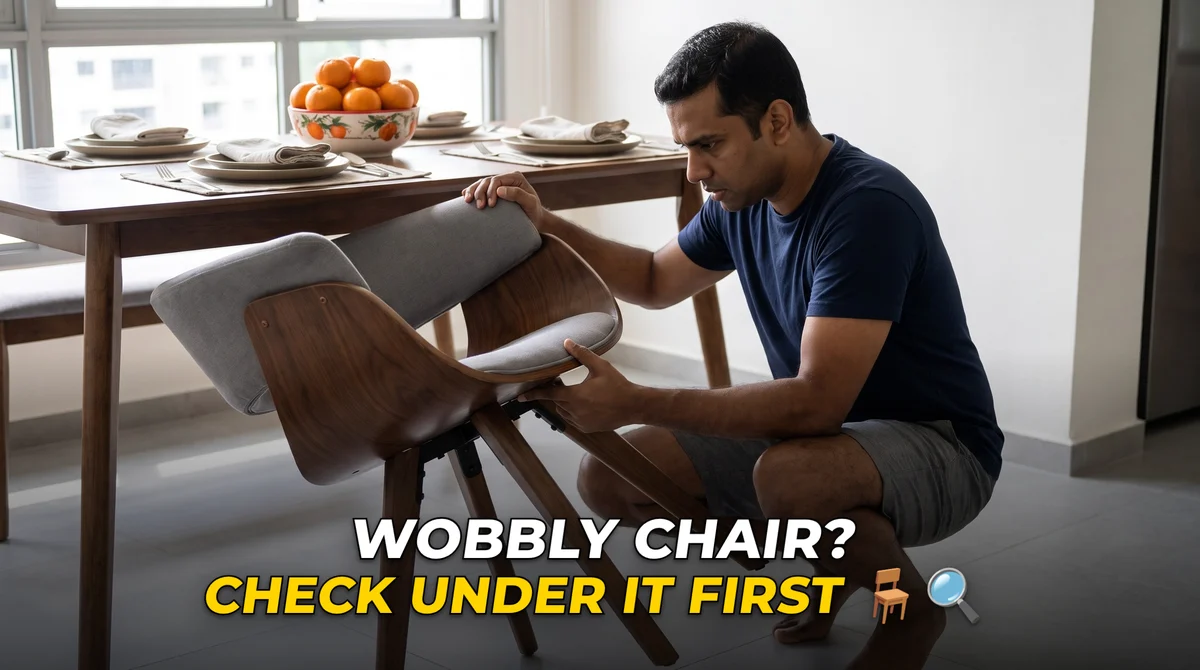
Picture a 5-room flat in Punggol the week before Christmas. Six chairs get used every day, but on the open house afternoon closer to twenty people cycle through them, someone's uncle leans back on two legs, and the chairs are dragged across the tiles a hundred times between lunch and tea. By the end of the weekend two of them wobble.
The problem
Dining chairs carry more stress per kilogram of material than anything else in the flat. Every time someone sits down, the joint between the leg and the seat frame takes a shock. Every time a chair is pushed back, it takes a sideways twist. Leaning back on the rear legs puts the whole load through two joints instead of four. A chair rarely breaks. It loosens. First a faint creak, then a wobble you feel through your seat, then a leg that splays a few degrees and scratches the floor.
Where it goes wrong is almost always the same place: the corner where the leg meets the seat rail. On a well-made chair that corner is a proper wood joint reinforced with a glued corner block. On a cheap one it's a screw driven into the end of a soft piece of timber, held by a stamped metal bracket, and it works loose within a year in our humidity.
Why it happens
Wood moves. Singapore swings between an air-conditioned dining room at night and an open window all day, and the timber in a chair frame expands and shrinks with each cycle. A joint that was only just tight when it left the factory has no margin for that. Add a festive weekend of heavy use and the movement becomes permanent. Softer, cheaper timbers and finger-jointed offcuts under a veneer move more and grip screws worse than solid hardwood does.
What to do about it
Turn the chair over
The underside tells you more than the top. Look for a solid triangular corner block glued and screwed across each corner of the seat frame. Look for the leg entering the rail, not just butting against it. A bolt with a threaded insert is fine. A single wood screw into end grain with a bent metal plate is the thing to walk away from. If you're not sure what a mortise or a stretcher is, our furniture glossary covers the terms in plain words so you can ask the right question.
Do the rack test in the showroom
Hold the top of the backrest and push it sideways, then front to back. A good frame moves as one piece with no give at the corners. Sit, lean back the way your uncle will, and listen. Then lift one front leg off the floor and watch the others. Any diagonal twist you can feel now will be a wobble by Chinese New Year. Do this to every chair you're considering, not just the display one.
Read the frame material honestly
Ask what the legs and rails are actually made of. Solid walnut, as in the Arden Dark Walnut Dining Chair, is dense and holds a joint through years of humidity cycling. "Wood finish" or "walnut colour" often means a veneer or a paint over something softer. The whole dining chair range is built on solid walnut frames because this is the part that fails first on chairs that aren't.
Check the seat pan and the feet
An upholstered seat should be fixed to the frame from underneath with bolts, not staples alone, so it can be tightened later. Run your hand round the fabric edge to see that it's wrapped and not just glued. Then look at the feet. Felt or nylon glides mean the chair slides instead of jolting, and that jolt is what loosens joints on tiled floors. We go into comfort for long sittings, including mahjong nights, in this earlier piece.
Before you decide
- Have you looked underneath every chair for corner blocks and proper joints?
- Did you rack-test the chairs, including leaning back on the rear legs?
- Do you know the actual frame timber, not just the finish name?
- Is the seat bolted on so it can be re-tightened?
- Are the feet fitted with glides for your floor type?
- Will the chairs arrive in time to be sat on for a week before guests do?
Questions people ask
How many extra chairs do I need for festive hosting?
Count the seats you fill on a normal weekday, then the largest number you host at once. Buy for the everyday number in a matching set and keep two or four of the same model spare in a bedroom, rather than a different style pulled in on the day.
Can a wobbly dining chair be fixed?
If it's bolted and blocked, usually yes, by tightening from underneath. If the joint is a screw into soft end grain, the timber is already stripped and tightening won't hold for long.
Are upholstered chairs a bad idea with curry and rendang on the table?
Not if the fabric is tightly woven and you blot spills early. Fabric seats are far more comfortable for a three-hour lunch than bare wood, which is why the festive table needs them most.
If you're topping up chairs before the festive season, message the showroom team on WhatsApp with your table size and how many you need. They'll confirm which models are on the floor at Central or South and what lead time looks like for your set.